
Risk map
What can go wrong when you license company data to AI?
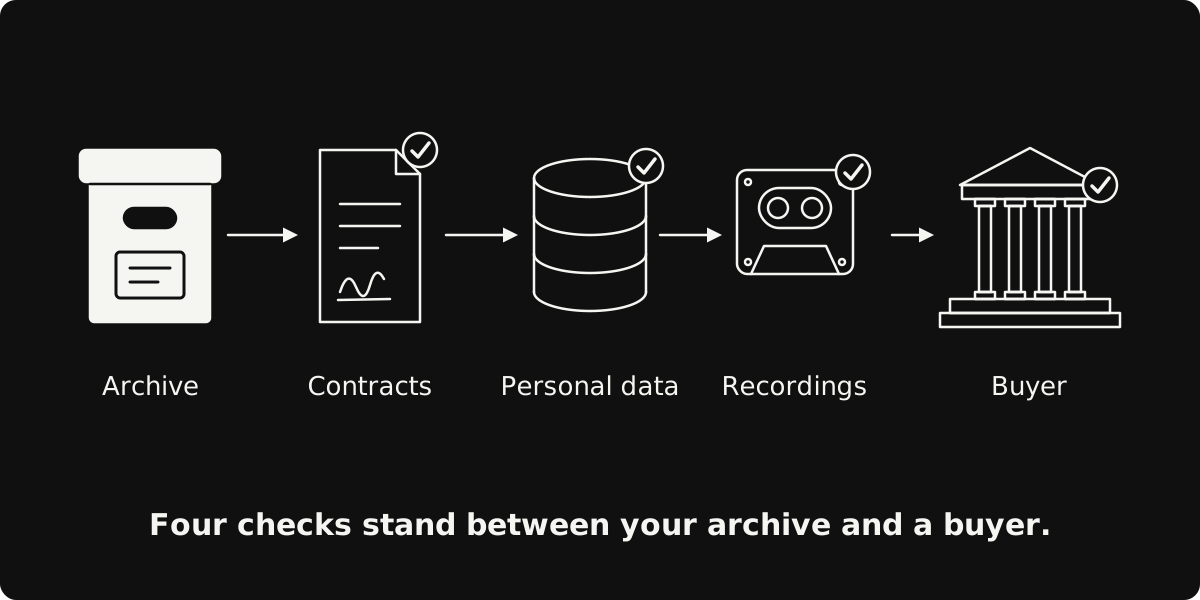
We found no licensing company that has been sued yet. The exposure is real, priced and mostly written into the contracts. Each risk below names who can enforce it, the cases with dates, and what companies do about it.
What law firms tell companies
Two firms have published advice for companies thinking about this kind of deal. They agree on the order of work. Gather the right people and the facts first. Decide what to exclude. Then talk to a buyer.
- Frankfurt Kurnit Klein & Selz. It lists these risks: competing ownership claims, privacy-policy promises, CCPA sale rules, the limits of de-identification, protected employee activity, reputational harm, and public disclosure duties under California's AB 2013 and the EU AI Act. It also notes that trained data cannot practically be pulled back out. Its advice has six steps. Take an inventory of systems. Bring legal, privacy, security, HR and communications people together before any offer. Review customer and vendor agreements. Exclude high-risk categories. Choose the de-identification provider jointly with the buyer. Document the decisions. law-firm alert
- Sidley Austin. It covers chain of title, which means who owned the data and how ownership passed along. It also covers scope limits by model version and use. It covers the contested question of whether a trained model is a derivative of its training data. Representations and indemnification are increasingly standard. So are deletion and audit rights. law-firm alert
We searched for alerts on licensing Slack or email archives from seven other large firms: Cooley, Orrick, Goodwin, WSGR, Fenwick, Latham and Perkins Coie. We found none on that exact topic. Alerts on neighboring points appear in the risk sections below:
- Hunton on Slack's API terms.
- Fenwick on insurance exclusions.
- Mayer Brown on the Justice Department's data rule.
- Jackson Lewis on reading SOC 2 reports.
- Debevoise on privilege.
- WilmerHale on state data broker laws.
The fifteen risks
- Customer contracts, NDAs and data processing agreements
- Privacy law: the CCPA sale rule and state laws
- Data broker registration
- GDPR and UK GDPR
- Employees, unions and protected activity
- Call and meeting recordings: wiretap and biometric laws
- Health, financial, education and children's data
- Privilege, copyright, code licenses and export controls
- Platform and API terms
- De-identification and re-identification
- FTC deception orders and model deletion
- Warranties, indemnities and liability caps in buyer terms
- Bankruptcy, wind-downs and acquisitions
- Data security and breach
- Who the buyer is: the DOJ bulk-data rule
Risk 1
Customer contracts, NDAs and data processing agreements
No case against a licensing company found. Vendor cases exist.
What it is
If your company holds data as a processor or service provider, or under an NDA, you may have no right to license it. Customer and partner agreements often limit use to the service. Email and chat carry other companies' confidential information, and a Slack Connect export carries the other organization's messages.
Under the GDPR a processor may act only on the controller's documented instructions, and the EDPB treats a processor that goes beyond them as a controller. Under the CCPA a service-provider contract must bar selling or sharing the data.
Who can enforce it
Customers, partners and vendors suing on contract. Trade-secret owners under the Defend Trade Secrets Act, which reaches use by someone who knew the secret came under a duty to limit use. EU and UK regulators for processors.
Cases and sources
- 21 Nov 2025. Khan v. Figma (N.D. Cal., No. 3:25-cv-10054): a customer alleged breach of contract and trade-secret misappropriation over AI training on customer designs. Bloomberg Law reported that the court compelled arbitration on 11 May 2026. This is a vendor case, not a case against a licensing company.news or law-firm summary
- 26 Aug 2026. A plaintiffs' firm announced an investigation of HubSpot after it reversed a default-on AI training setting. No suit was confirmed.news or law-firm summary
- 18 Sep 2026. In the Spirit Airlines sale, a software vendor (Springshot) objected that part of the data is its property, and an engine maker raised confidentiality agreements.news or law-firm summary
- 2026. Common Paper's benchmark of 16,140 signed agreements found 14% of cloud service agreements bar AI training on customer data, up from under 1% in 2024. The default clause permits training on aggregated, de-identified data, which covers a vendor's own use and does not authorize a customer to resell its clients' data (our reading).primary source
What we could not establish. We found no reported case where a company was sued for licensing an NDA-covered archive to an AI buyer.
How companies reduce it
- Sort every system's data into three piles: your own, held for others, and belonging to third parties.
- Pull customer, partner and vendor agreements that carry confidentiality or data-use clauses, and exclude what they bar.
- Get written consent where a counterparty's content is in scope.
Talk to counsel. Commercial counsel reads each clause and decides what it permits. We do not decide any of this for you.
Risk 2
Privacy law: the CCPA sale rule and state laws
Priced penalties for sharing data against a company's own promises. No archive-licensing case.
What it is
Under the CCPA, giving personal information to a buyer for money or other valuable consideration is a sale, and revenue share counts. Employee and business-contact data have been covered in California since 1 Jan 2023. Email contents are sensitive personal information unless the business is the intended recipient.
Data escapes the sale rules only if it is deidentified: it cannot reasonably be linked to a person, the business takes reasonable measures, publicly commits not to re-identify, and binds recipients by contract to the same. A sale also needs a written contract with purpose limits, audit rights and a right to stop and fix misuse.
Most other state laws exclude employment-context data, so California is the outlier. Customer records in a CRM or ticket system stay covered. Connecticut's 2026 amendments tighten sensitive-data sales and add a notice line on training large language models.
Who can enforce it
The California Attorney General and the California Privacy Protection Agency (CalPrivacy). Other state attorneys general under their own laws. California offers no notice-and-cure period. Base administrative fines run up to $2,500 per violation or $7,500 per intentional violation, and we did not verify the inflation-adjusted figures.
Cases and sources
- 21 Feb 2024. DoorDash, $375,000: customer data traded into a marketing cooperative counted as a sale.primary source
- 12 Mar 2025. Honda, $632,500: sharing data without the required contract terms.primary source
- 1 Jul 2025. Healthline, $1.55M: purpose limitation and missing contract terms.primary source
- 30 Sep 2025. Tractor Supply, $1.35M: employee and applicant notices. The first CalPrivacy decision on that point.primary source
- 8 May 2026. General Motors, $12.75M: sold driving and location data to data brokers contrary to its own policy. Orders: no sales to brokers for five years, delete retained data and ask the brokers to delete theirs. California's largest CCPA penalty to date.primary source
What we could not establish. None of these cases involves a company licensing an employee or customer archive to an AI buyer. They show how regulators price a data deal that contradicts a promise.
How companies reduce it
- Treat a license for money as a sale unless the data clearly meets the deidentified test.
- Exclude whole categories of data instead of relying on scrubbing.
- Put the required terms in a written buyer contract.
- Update notices before you collect for a new purpose, never after.
Talk to counsel. Privacy counsel decides whether a transaction is a sale and what notice it needs. We do not decide any of this for you.
Risk 3
Data broker registration
Registries exist and fines are small. Whether they reach companies that license archives is open.
What it is
California, Vermont, Texas and Oregon register data brokers, New Jersey signed a regime in Jun 2026, and Connecticut registration starts 1 Jan 2027. Each definition centers on collecting and selling or licensing personal data about people the business has no direct relationship with.
Our reading of the statute text: California, Vermont, Oregon and New Jersey turn on direct relationships, and Vermont, Oregon and New Jersey list employees and customers as direct-relationship people, so a company licensing only its own employee and customer data likely sits outside Vermont and Oregon. Mixed archives are unclear. Former employees, vendors' staff and people named in emails may not fit California's three-year product-use wording, and Texas has no direct-relationship test.
A finder who never receives or discloses personal data fits neither "collects" nor "sells" on the plain text. The caveats: California tells courts to disregard intermediate steps built to avoid a sale, and taking samples or running a data room could count as collecting.
Who can enforce it
CalPrivacy, the Texas Attorney General and Secretary of State, the Vermont Attorney General, Oregon's Department of Justice and, from 2026, New Jersey.
Cases and sources
- 13 Jan 2025. The Texas Attorney General sued Allstate and Arity, including for failure to register. We did not find the outcome.primary source
- 8 Jan 2026. CalPrivacy fined Datamasters $45,000 and S&P Global $62,600 for registration failures.primary source
- 11 Aug 2026. CalPrivacy fined LocateSmarter $116,490, its first action under both the CCPA and the Delete Act. California's form now asks whether a broker sold consumers' data to a generative-AI developer, and Stanford HAI counted 32 brokers reporting such sales.primary source
What we could not establish. We found no regulator guidance or enforcement on archive licensing and registration, and none on finders. We did not check whether any company in our buyer directory is registered.
How companies reduce it
- Ask counsel whether your archive holds data about people you have no direct relationship with, and in which states they live.
- Ask any company you use which data broker registries it appears on.
Talk to counsel. Privacy counsel decides whether you need to register. We do not decide any of this for you.
Risk 4
GDPR and UK GDPR
Strong regulator positions. No case against a licensing company.
What it is
The GDPR reaches a US company that has an EU establishment or offers to or monitors people in the EU, and the UK GDPR works the same way for the UK. We did not research that threshold in detail.
Core duties for a data license: use data only for compatible purposes (Art. 5(1)(b) and 6(4)), tell people when data came from a third party and a new purpose arises (Art. 14), protect special categories (Art. 9). Fines run to EUR 20M or 4% of turnover (Art. 83(5)).
The EDPB's Opinion 28/2024 says a model trained on personal data cannot, in all cases, be considered anonymous. It addresses models, so applying it to a company that licenses data is by analogy. The ICO's anonymisation guidance says pseudonymised data stays personal data in the hands of anyone holding the extra information. For employee data, Article 88 lets member states and collective agreements set their own rules, and the CJEU confirmed those rules still respect Articles 5, 6 and 9 (C-65/23, 19 Dec 2024).
Who can enforce it
National data protection authorities, the ICO, individuals, and works councils in countries such as Germany.
Cases and sources
- 18 Dec 2024. EDPB Opinion 28/2024 on AI models and personal data.primary source
- 10 Apr 2025. Italy's Garante announced a EUR 5M fine against Luka, the maker of Replika, for lacking a valid legal basis, including for developing a language model. This is a model-builder case, not a case against an archive licensor.news or law-firm summary
- 7 Jul 2026. The EDPB adopted draft guidelines on anonymisation with no-singling-out, no-linkage and no-inference criteria. Consultation runs to 30 Oct 2026. They are a draft.primary source
What we could not establish. We found no German case on licensing collaboration archives, and the works-council point rests on commentary, not the statute text we read.
How companies reduce it
- Flag every EU and UK person in the archive and exclude them unless counsel clears a lawful basis.
- Do not treat name-swapping as anonymisation.
Talk to counsel. Privacy counsel with EU or UK experience. An external data protection officer is an option. We do not decide any of this for you.
Risk 5
Employees, unions and protected activity
The most active objectors so far.
What it is
Section 7 of the National Labor Relations Act protects employees who talk about pay and working conditions, union or not, and Section 8(a)(1) bars interference and surveillance.
Chat archives contain that talk. Frankfurt Kurnit's checklist lists protected activity among the risks of licensing workplace data.
In a union shop, licensing records of the workforce may raise a duty-to-bargain question. No Board authority decides that point, so the theory rests on analogy.
Notice-of-monitoring laws in New York, Connecticut and Delaware fix the purpose employees were told, which feeds a purpose-limitation argument (our reading).
Who can enforce it
The National Labor Relations Board, unions, employees, state attorneys general, and works councils in Europe.
Cases and sources
- 18 Aug 2026. Spirit Airlines: the flight attendants' union (AFA-CWA) filed a limited objection asking the court to exclude flight attendant records (175,658 employee records back to 1986, 3,426,618 payroll records, tax forms and crew pairings) or add an employee-confidentiality review. It did not ask to unwind the auction.primary source
- 4 Sep 2026. Spirit Airlines: the pilots' union (ALPA) objected, citing confidential training and fatigue records and FAA safety-program data, and filed again on 25 Sep 2026. Other unions reportedly joined.primary source
- 2 Oct 2026. EPIC and Professor Seema Patel filed an amicus brief against the sale of employee data.news or law-firm summary
What we could not establish. We found no NLRB charge, complaint or decision about licensing employee messages for AI training.
How companies reduce it
- Exclude HR files, payroll, health and benefits, union communications and pay-and-conditions channels.
- Tell employees about a new purpose before you collect, where you can.
- In a union shop, involve labor counsel before any offer.
Talk to counsel. Labor and employment counsel. We do not decide any of this for you.
Risk 6
Call and meeting recordings: wiretap and biometric laws
The highest-risk category. Live cases against vendors.
What it is
The federal Wiretap Act bars intentionally disclosing contents you know came from an unlawful interception, and the one-party-consent defense fails if the interception serves a criminal or tortious purpose. California requires all-party consent for confidential calls. Illinois' biometric law covers voiceprints, with statutory damages of $1,000 per negligent violation and $5,000 per reckless or intentional one (per secondary sources).
Who can enforce it
Private plaintiffs and class-action lawyers, plus state prosecutors under their own statutes.
Cases and sources
- 13 Aug 2026. In re Otter.AI Privacy Litigation (N.D. Cal., No. 5:25-cv-06911): the court let Wiretap Act, California Invasion of Privacy Act and Illinois voiceprint claims proceed. It found the plaintiffs plausibly alleged the vendor acts as a third-party eavesdropper because it keeps recordings and uses them to train its own systems. The case is at the discovery stage, with no class certified.primary source
- 10 Feb 2025. Ambriz v. Google (N.D. Cal.): a vendor that has the capability to use call data for itself can count as a third party.primary source
- 10 Mar 2026. A Fireflies voiceprint suit (Cruz, filed 18 Dec 2025) was voluntarily dismissed, and further suits followed.news or law-firm summary
- 14 Aug 2026. Spirit's sale schedule lists 30,865,471 call recordings as "Not Included", the one asset class with all-party-consent and biometric exposure.primary source
What we could not establish. We found no case holding a company liable for licensing its own lawfully recorded calls. The Otter reasoning is the analogy most likely to be argued against a company that passes raw recordings to a lab. That is inference, not a holding.
How companies reduce it
- Treat recordings as their own category and exclude them by default.
- Check recording notices, whether a voiceprint or speaker-ID feature ever ran, and the callers' states.
Talk to counsel. Counsel with California and Illinois recording-law experience. We do not decide any of this for you.
Risk 7
Health, financial, education and children's data
Federal rules with their own sale bans. No case against a licensing company.
What it is
HIPAA bars covered entities and their business associates from selling protected health information without authorization (45 CFR 164.502(a)(5)(ii)), and its de-identification safe harbor removes 18 identifier types, including voice prints. Name-swapping alone does not meet it in free text (our reading).
GLBA and Regulation P require notice and a chance to opt out before disclosing nonpublic personal information to unaffiliated companies (12 CFR 1016.10 and 1016.11). FERPA requires signed consent for personal information from education records (34 CFR 99.30). The amended COPPA rule has a separate parental-consent option for third-party disclosure, with compliance due 22 Apr 2026.
Substance-use treatment records fall under 42 CFR Part 2, and a public company selectively sharing material nonpublic information triggers Regulation FD. Any of these can make a whole system off limits.
Who can enforce it
HHS, banking regulators and the FTC, the Education Department, the SEC and state attorneys general.
Cases and sources
- HIPAA sale ban, eCFR text.primary source
- GLBA Regulation P sections 1016.10 and 1016.11.primary source
How companies reduce it
- If your clients are health, financial, education or children's customers, treat that archive as excluded until counsel clears it.
Talk to counsel. Counsel in the relevant sector. We do not decide any of this for you.
Risk 8
Privilege, copyright, code licenses and export controls
Settled principles. Few AI-specific rulings.
What it is
Privilege belongs to the company, and voluntarily giving privileged email to a commercial buyer generally waives it. A buyer is not covered by common-interest privilege. In a bankruptcy, the trustee controls privilege and can waive it.
Vendor decks, licensed documents and client deliverables are copied when an archive is delivered. Repositories with GPL or other license obligations, or code written for clients, need license review first. Whether a copyleft license reaches a model trained on the code is untested.
Releasing source code or technical data to a foreign person inside the US counts as an export under the EAR (15 CFR 734.13(a)(2)) and ITAR (22 CFR 120.50(a)(2)). Engineering chat, CAD files and code delivered to a buyer with foreign-national staff or an offshore labeling team are the trap (our reading).
Who can enforce it
Opposing litigants for privilege. Copyright and license holders. The Commerce and State Departments for exports.
Cases and sources
- 17 Feb 2026. United States v. Heppner (S.D.N.Y., Judge Rakoff): chats with a consumer AI tool were not privileged, partly because the provider's terms allowed training and disclosure. The same logic applies to privileged email licensed to an AI buyer (our analysis).news or law-firm summary
- 23 Jun 2025. Bartz v. Anthropic: training on lawfully acquired books was fair use and the pirated library was not. The $1.5B settlement, about $3,000 per work, received final approval on 20 Jul 2026. The lesson buyers drew is provenance.news or law-firm summary
- 16 Sep 2026. Doe v. GitHub (9th Cir.): the court affirmed dismissal of DMCA 1202(b) claims. License-contract claims remain in the district court.news or law-firm summary
What we could not establish. None of these rulings decides a licensing company's liability for authorizing the copying of a business archive. We did not research export law beyond the two sections cited.
How companies reduce it
- Filter privileged and export-controlled material out before transfer, on counsel's instruction.
- License-scan code. Get partner consent for partner-owned content.
Talk to counsel. Litigation counsel for privilege, software-license review for code, and export-control counsel. We do not decide any of this for you.
Risk 9
Platform and API terms
Binds the extraction route more than the customer.
What it is
The clauses that bar training a model, bulk export and persistent copies sit in developer and API terms. They bind apps that pull your data, including a buyer's connector. The customer-facing agreements we read say the customer owns its data, and none contained a sentence barring a customer from handing its own admin export to a buyer. That reads "not found", and the route used to extract the data decides which text applies.
Slack's API terms say an app offered outside the customer's organization may not use API data to train a large language model and may not bulk export message data except under an additional agreement. Google's Workspace API user-data policy bars transferring or using user data to train a non-personalized AI or machine-learning model. Microsoft's API terms bar building databases or copies beyond the app's purpose and redistributing or reselling the data. HubSpot's terms say it may train its own AI on customer data unless you opt out.
Slack Connect channels carry the other organization's messages in your export, and Slack's text does not say who owns shared-channel content.
Who can enforce it
The platform, by contract: ending access or suing the app provider. Salesforce can change the Slack terms on notice.
Cases and sources
- Slack API terms of service.primary source
- Google Workspace API user data and developer policy.primary source
- Hunton's alert on the Slack terms.news or law-firm summary
What we could not establish. We found no enforcement against a licensing company. We did not read Microsoft's product terms, Slack's supplemental terms or Notion's and Intercom's terms.
How companies reduce it
- Ask each buyer which route it uses to extract data (your own admin export, or an API connector) and which platform terms it accepts.
- Check settings like HubSpot's AI-training opt-out.
Talk to counsel. Commercial counsel. We do not decide any of this for you.
Risk 10
De-identification and re-identification
The weak joint in every company's promise.
What it is
Every company in our buyer directory leans on removing or replacing names. Regulators and researchers say that does not settle identifiability. The FTC wrote in 2024 that data is anonymous only when it can never be associated back to a person. The DOJ's bulk-data rule counts data whether or not it is anonymized or pseudonymized.
The companies' methods keep records linkable on purpose. micro1's David Revland, who works on human data, said names become consistent stand-ins across tools (self-reported).
The Spirit sale terms require de-identification while preserving referential integrity across the data set. The flight attendants' union argued that this lets identities be rebuilt.
Frankfurt Kurnit's checklist says removing identifying details from millions of messages is much harder than removing names.
Who can enforce it
No single enforcer. Each law above applies its own test.
Cases and sources
- FTC: "No, hashing still doesn't make your data anonymous."primary source
- Staab et al. found language models inferred personal attributes from text with up to 85% top-1 accuracy and that text anonymization tools were ineffective.primary source
- Lermen et al. matched pseudonymous accounts across platforms at up to 68% recall and 90% precision, where classical methods were near zero.primary source
- Palacios et al., on 100 pediatric oncology notes: an LLM method beat a deployed de-identification system (F1 0.918 against 0.779) and found 227 identifiers missing from the reference standard.primary source
- 5 Oct 2026. Spirit's court-appointed ombudsman wrote that technology has far outpaced the law on re-identification and AI inference.primary source
What we could not establish. The research papers are arXiv abstracts we read, not peer-reviewed findings about your data.
How companies reduce it
- Exclude categories of data instead of relying on scrubbing.
- Pick the de-identification provider jointly with the buyer, and require certification to your satisfaction.
- Limit raw-data access and avoid giving the buyer direct system access.
- Ask for a re-identification test, and ask how consistent stand-ins are handled.
Talk to counsel. Privacy counsel and an independent de-identification specialist. We do not decide any of this for you.
Risk 11
FTC deception orders and model deletion
Broken-promise cases are the ones that bite.
What it is
The FTC said in 2024 that quietly and retroactively loosening terms or privacy policies to allow AI training may be unfair or deceptive. That post came from the previous FTC leadership, and we found no replacement or withdrawal.
FTC remedies have reached models as well as data: Cambridge Analytica (2019), Everalbum (2021), WW/Kurbo (2022), Rite Aid (2023) and Ring and Alexa (2023). If a regulator ordered a buyer to delete models trained on unlawfully obtained data, the buyer's warranty claims would land on the licensing company (our analysis).
Who can enforce it
The FTC and state attorneys general under their own unfair-practice laws. The FTC Act has no private right of action.
Cases and sources
- 30 Mar 2026. Match Group and OkCupid: the FTC alleged nearly 3 million users' photos, location and demographic data went to an AI company in which OkCupid's founders were investors, against the privacy promises and with no contractual limits. The order bars misrepresentations. It carried no money. Press reported the recipient deleted the photos and the models trained on them.primary source
- 4 May 2026. Kochava: a stipulated order requiring affirmative express consent for sensitive-location data sales.primary source
- 22 Feb 2024. Avast: $16.5M and deletion of data sent to a subsidiary and any derived products or algorithms.primary source
What we could not establish. FTC staff opened a non-public inquiry into Reddit's AI data licensing, disclosed in March 2024. We found no outcome.
How companies reduce it
- Check what your privacy notices, handbooks and customer terms said when you collected the data.
- Do not change them quietly. Get fresh, specific consent for a new purpose.
Talk to counsel. Privacy counsel. We do not decide any of this for you.
Risk 12
Warranties, indemnities and liability caps in buyer terms
The contract is where the risk moves.
What it is
No company in our directory publishes its full contract. The few terms that are public put the risk on the company that licenses the data. SimpleClosure's terms list six representations and a broad indemnity from that company, and cap SimpleClosure's own liability at the greater of six months of amounts paid or $100.
Troveo's guide says the data owner promises to hold the rights and to have acquired the data lawfully, with caps typically tied to deal value. Handshake says data partners remain responsible for the legal compliance of their transfer. micro1's referral terms let it reclaim payouts it later decides were not owed.
Who bears the loss after a breach at a buyer is not public for any company-data deal. Insurance may not respond: ISO released generative-AI exclusion forms for general liability, and Fenwick wrote that broad AI exclusions are appearing in D&O and employment-practices forms.
Who can enforce it
The other party to the contract, by contract claim.
Cases and sources
- SimpleClosure terms: company warranties, indemnity and a $100 cap on its own liability.primary source
- Troveo's guide on warranties and indemnity caps.primary source
- Fenwick on emerging AI exclusions in insurance policies.news or law-firm summary
What we could not establish. We found no public sample term sheet. Most buyer statements about their own terms are self-reported.
How companies reduce it
- Ask for the full terms in writing before you share a sample.
- Ask which indemnities sit outside the liability cap, and which of your representations you can qualify.
- Ask your insurance broker, in writing, whether your policies respond to a claim from an AI data deal.
- Use the side-by-side checklist on the buyer comparison page.
Talk to counsel. Commercial counsel and an insurance broker. We do not decide any of this for you.
Risk 13
Bankruptcy, wind-downs and acquisitions
Spirit is the live test. Its sale is not approved.
What it is
In bankruptcy, sections 363(b)(1) and 332 of the Bankruptcy Code send a sale of consumer personal information through a court-appointed privacy ombudsman, who reports to the court and has no veto. The statute defines that information by consumer transactions, so employee and business data fall outside it (our inference).
A shutdown outside bankruptcy has no ombudsman and less court supervision. The CCPA's acquisition exception needs a buyer that takes over the business, which a license to an AI lab does not. In Delaware, selling substantially all assets needs board and majority stockholder approval, and directors who make provision for known and likely claims are shielded from personal liability (8 Del. C. 281(c)). That shield does not cover fraudulent transfers or earlier breaches of duty.
Spirit's sale terms are "as is" with no seller representations. That is a bankruptcy feature. An operating company should not expect it, and SimpleClosure's terms ask for broad representations.
Who can enforce it
The bankruptcy judge, the US Trustee, the ombudsman, state attorneys general, objecting parties. Outside bankruptcy, creditors, customers and regulators.
Cases and sources
- 14 Aug 2026. Spirit Airlines auction (Bankr. S.D.N.Y., No. 25-11897, Judge Lane): Google $10M, Mercor $7.5M as alternate. micro1 later gave notice of a competing bid, reported at $12.5M.primary source
- 5 Oct 2026. The court-appointed ombudsman, Lucy L. Thomson, said from a privacy perspective approval would be appropriate and that she did not investigate or reach any conclusion on risk to employees. Tonic.ai is the de-identification agent for unstructured data. She also noted Mercor's security incident and that micro1 proposed to de-identify the data itself.primary source
- 6 Nov 2026. Hearing on the sale, moved from 14 Oct 2026 by a court notice that Travel Weekly reported on 9 Oct 2026. No sale order as of 10 Oct 2026. We will update this entry after the hearing.news or law-firm summary
- 16 Apr 2026. SimpleClosure Asset Hub and Cielo24: a shutdown service says it processed nearly 100 company-data sales in about a year at $10,000 to $100,000 per company (self-reported), and press reported that defunct Cielo24 sold 13 years of Slack, email and Jira history for "hundreds of thousands of dollars". Privacy advocates objected, and a policy group asked the Senate Commerce Committee in April 2026 for FTC oversight. We found no suit against a company over such a deal.news or law-firm summary
- 27 Jun 2025. 23andMe: 27 states and DC objected, the ombudsman recommended affirmative consent, and the sale to a nonprofit for $305M was approved with resale limits and a perpetual deletion right.news or law-firm summary
What we could not establish. We did not check PACER. We found no state attorney general objection in Spirit, and no case on data-subject claims against a dissolved company.
How companies reduce it
- Bring insolvency and corporate counsel in before you list anything.
- Get the board and stockholder approvals your state requires, and reserve for known claims.
Talk to counsel. Insolvency and corporate counsel. We do not decide any of this for you.
Risk 14
Data security and breach
Thin published proof. One reported incident at a large buyer.
What it is
In every model we read, the buyer or marketplace holds your raw data at some stage. The published proof of security is thin. On the pages we read, Mercor, Protege and Defined.ai claim a certification, and no other company in our directory does. A certification claim is something to verify, not a conclusion.
You still carry duties of your own. California requires reasonable security alongside a sale contract, and all 50 states have breach-notification laws. Who must notify after a breach at a licensee depends on the contract and on whether the data was licensed or transferred outright (our analysis).
Who can enforce it
State attorneys general under breach-notification laws, the FTC, contract counterparties, and class-action plaintiffs.
Cases and sources
- 27 Mar 2026. Reported incident at Mercor: a poisoned release of the open-source LiteLLM library was live for about 40 minutes and Mercor was affected. Reports put the scope at about 4 TB, including a user database and video interviews and identity documents, with names and Social Security numbers of 40,000+ contractors and customers. Threat groups claimed responsibility. These figures are reported claims.news or law-firm summary
- Mercor's own post says that of about 5 million experts only a very limited subset had sensitive information affected, that customer impact was minimal, and that it added credential rotation, penetration testing and monitoring.primary source
- 21 Apr 2026. Reported class actions allege Mercor mishandled contractor data (for example Ananthula v. Mercor.io Corp., N.D. Cal., No. 3:26-cv-03362). Reports count at least seven. These are allegations, and Mercor disputes the claims.news or law-firm summary
- Apr 2026. Meta reportedly paused work with Mercor, and OpenAI said it was investigating. The data involved is contractor and applicant data, and no company-archive data was reported exposed.news or law-firm summary
- 5 May 2026. A complaint alleges the compliance vendor behind LiteLLM's SOC 2 and ISO reports fabricated hundreds of them, an allegation we did not verify. Jackson Lewis advises reading a SOC 2 report's scope, test dates, auditor independence and whether the results look realistic.news or law-firm summary
What we could not establish. We did not read the complaints in the Mercor suits, and the exact incident date differs between sources (24 to 27 Mar 2026). Mercor's trust center did not render for us.
How companies reduce it
- Ask who holds your raw data, where and for how long, and when it is deleted.
- Ask for the SOC 2 report itself, with scope, auditor and audit period, not a badge.
- Limit raw-data access. Do not give the buyer direct system access.
- Name one IT owner, turn on multi-factor sign-in and access logging for the export, and delete staging copies.
Talk to counsel. Counsel for notification duties. A CPA firm that performs SOC 2 audits and an independent penetration tester can read a buyer's proof. We do not decide any of this for you.
Risk 15
Who the buyer is: the DOJ bulk-data rule
A rule most companies have not heard of.
What it is
The Justice Department's Data Security Program (28 CFR Part 202, in force since 8 Apr 2025) bars data brokerage with countries of concern and covered persons. A sale, license or similar transaction to a recipient that did not collect the data from the individuals fits its definition of data brokerage. For other foreign recipients it requires contract terms barring onward sale to countries of concern.
Bulk thresholds count data whether or not it is anonymized, pseudonymized, de-identified or encrypted: over 10,000 US persons for health or financial data, and over 100,000 for covered personal identifiers. Civil penalties reach the greater of $368,136 or twice the transaction value. A names-and-emails-only archive is excluded from covered personal identifiers, while payroll, health and financial data inside HR email can cross a threshold (our reading).
The Protecting Americans' Data from Foreign Adversaries Act bars data brokers from making sensitive data, including private communications, available to a foreign adversary. The FTC sent reminder letters to 13 brokers on 9 Feb 2026.
Who can enforce it
The Justice Department's National Security Division and the FTC. Mayer Brown reports that plaintiffs have used rule violations as predicates for Wiretap Act claims, although the program has no private right of action.
Cases and sources
- 28 CFR Part 202 as published on the eCFR.primary source
- 9 Feb 2026. FTC reminder letters to 13 data brokers about their obligations under the foreign-adversary data law.primary source
What we could not establish. We found no public enforcement action against a company licensing data under either rule. A secondary claim that full enforcement began on 6 Oct 2026 is unverified.
How companies reduce it
- Ask who owns the buyer, and whether any foreign person will have access.
- Make sure the contract carries onward-transfer limits.
Talk to counsel. Counsel who handles national-security and export rules. We do not decide any of this for you.
Risks for the people who introduce you, including us
A finder who never touches your data has a smaller footprint. The same sources still raise questions for us. We answer them in how we work.
- Registration. On the plain text of the state data broker laws, a finder who never receives or discloses personal data does not "collect" or "sell". No authority decides the point. So we never accept samples, credentials or data-room access.
- Practicing law. Rules on unauthorized practice of law vary by state. The risk rises where a person reviews a specific contract and says whether it permits a license. We gather facts and checklists. We never judge a contract. Every legal conclusion goes to your counsel.
- Referral fees from lawyers. The ABA's model rules bar a lawyer from sharing fees with nonlawyers or paying for recommendations. A 2024 New York opinion applied that to an online service. We take no referral fee from any law firm.
- Endorsements and income claims. The FTC requires clear disclosure of any material connection behind a recommendation. It treats unsupported earnings claims as the most common allegation in business-opportunity cases. Our disclosure page says how we are paid. Every dollar figure on this site names its source.
- Discoverability. A written list of legal risks from a consultant may be discoverable. Our findings are not privileged. That is one more reason legal findings go through your counsel.
What this page does not settle
- Whether any company in our directory is a registered data broker in any state.
- Whether a one-time archive license counts as data broker activity in each state.
- How the Spirit sale ends, and how a court treats employee data in it. The hearing was moved from 14 Oct to 6 Nov 2026 (Travel Weekly, 9 Oct 2026).
- Whether the NLRB treats licensing workplace messages as an unfair labor practice.
- Who bears the loss when a buyer is breached. No company-data deal discloses it.
Where to go next
Start with the seven-question rights check, then compare the buyers and see what deals have been reported. If you want help gathering the facts your counsel will ask for, read the managed readiness service.
How this page was built
We read the sources behind each case and re-fetched the buyer pages. Several sites blocked automated fetches. So some statutory text came through secondary summaries, and the tags above say which.
If you find an error, a dated update or a missing case, tell us. We will fix the page.
